A significant proportion of Poland's housing stock was built before energy efficiency became a consideration in building regulations. Pre-1990s brick and panel constructions often have minimal wall insulation, single or double-glazed windows, and central heating systems running on coal or gas at below-optimal efficiency. Retrofitting these buildings involves a combination of envelope improvements and mechanical system upgrades — ideally carried out in a coordinated sequence.

Thermal envelope: where to start
Before replacing heating equipment, reducing heat loss through the building fabric produces the largest and most permanent improvements. In Polish conditions, the thermal envelope components that most commonly need attention are:
- Roof and attic floor — heat loss through an uninsulated attic is proportionally high because it represents the largest surface area. Adding insulation between attic joists or on the sloped roof surface is relatively low-cost and high-impact.
- External walls — external thermal insulation composite systems (ETICS, commonly known as "styropian" after the polystyrene boards most often used) are the standard retrofit method in Poland. Mineral wool boards are an alternative for buildings requiring vapour openness.
- Windows and doors — replacing single or older double-glazed windows with modern triple-glazed units can reduce window U-values from around 2.0–3.0 W/(m²·K) to below 0.9 W/(m²·K). Polish WT 2021 requires a maximum of 0.9 W/(m²·K) for windows in new construction.
- Floor over unheated basement or ground — often overlooked, insulating the ground floor or the basement ceiling reduces heat loss to cold ground or unheated spaces.
Heat pumps
Air-source and ground-source heat pumps extract heat from outdoor air or the ground and transfer it into the heating system. They operate on electricity rather than burning fuel, and their coefficient of performance (COP) means they deliver more heat energy than the electrical energy consumed — typically 2.5 to 4 units of heat per unit of electricity under Central European conditions.
Poland's electricity grid is still predominantly coal-based, which affects the net carbon calculation for heat pump use. However, combining a heat pump with a photovoltaic system — or as the grid decarbonises over time — reduces this dependency. Ground-source heat pumps require either a horizontal ground collector (requiring adequate garden area) or a vertical borehole, which is more common on smaller plots.
Heat pump suitability in Poland
- Air-source units function down to approximately -20°C, covering Polish winter conditions
- Most effective when combined with low-temperature heat distribution (underfloor heating or large-panel radiators)
- Polish government subsidy schemes have included heat pump replacement under the "Czyste Powietrze" programme
- Installation requires certified installer per Dz.U. 2015 poz. 1605 for systems using refrigerants
Photovoltaic panels
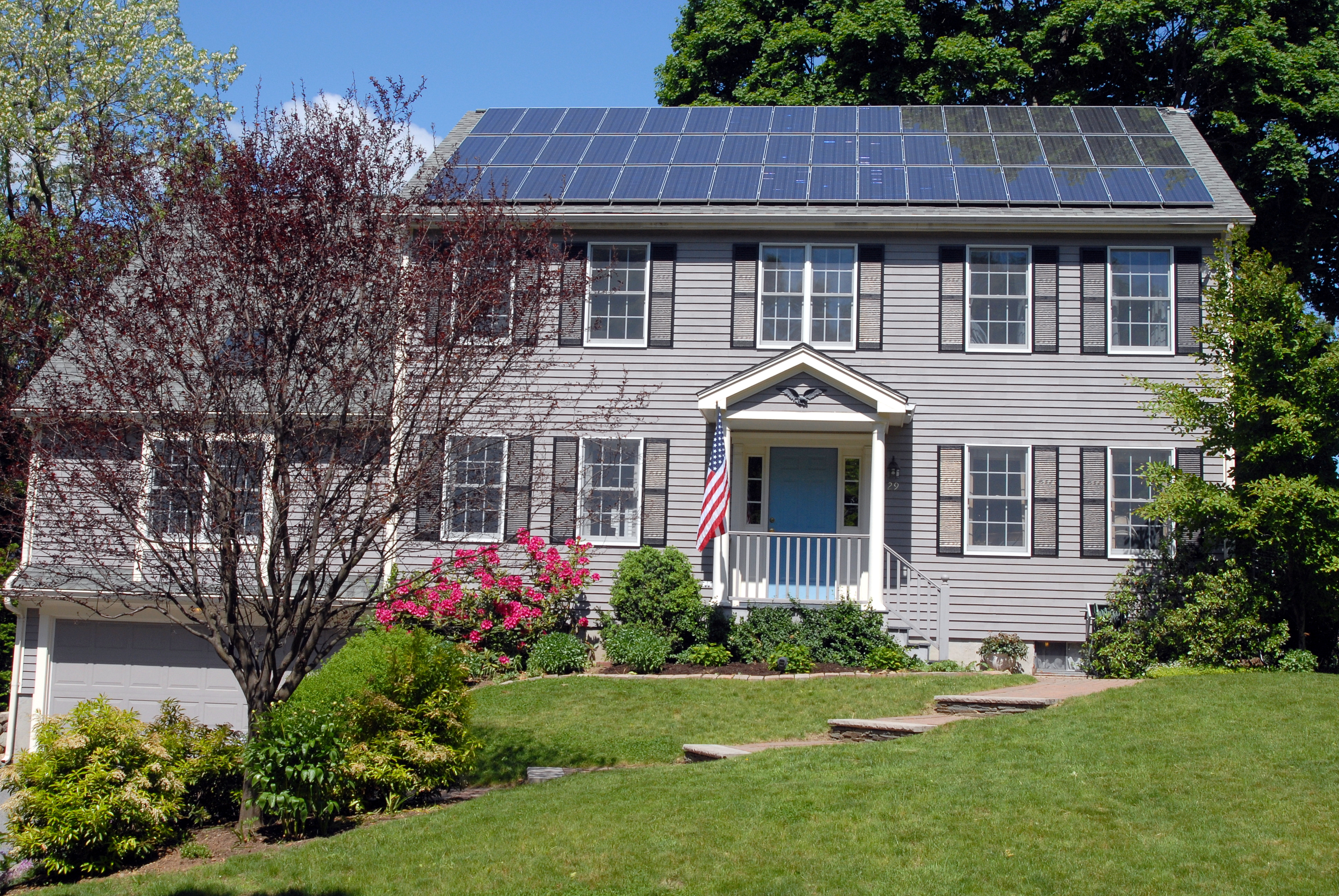
Poland's solar radiation levels are sufficient to make residential photovoltaic systems economically viable, particularly in southern and central regions. Annual horizontal irradiation in Poland ranges from approximately 1,000 kWh/m² in the north to around 1,100 kWh/m² in southern areas, based on European Commission PVGIS data.
A typical roof installation of 5–10 kWp on a single-family house can cover a substantial portion of annual household electricity needs, including operating a heat pump. Net metering or feed-in arrangements are governed by Polish energy law (Prawo energetyczne) and the rules for prosumers (prosument) introduced in subsequent amendments.
Mechanical ventilation with heat recovery (MVHR)
After improving insulation and reducing infiltration, a building needs controlled ventilation to maintain air quality. Natural ventilation through gravity-driven ducts becomes unreliable in well-sealed buildings and in mild weather. Mechanical ventilation with heat recovery (in Polish: rekuperacja or wentylacja mechaniczna z odzyskiem ciepła) extracts stale air from kitchens and bathrooms while supplying fresh air to living rooms and bedrooms. A heat exchanger transfers warmth from the outgoing air to the incoming fresh air.
Modern MVHR units achieve heat recovery efficiencies above 80–90%. This means that in winter, the incoming cold outdoor air is pre-warmed before entering the living space, substantially reducing the heating load required to maintain comfortable temperatures.
Sequencing retrofits effectively
The order of measures matters. Improving insulation first reduces the heating capacity needed from any new system. Installing a heat pump sized for an uninsulated house and then adding insulation later results in an oversized unit operating inefficiently at partial load. A common recommended sequence is:
- Roof or attic insulation
- Window and door replacement
- Wall insulation
- MVHR installation
- Heat pump or upgraded heating system
- Photovoltaic panels
Energy audits, available through Polish certified energy auditors, provide a documented assessment of a specific building's heat losses and the cost-effectiveness of different upgrade sequences.
Reference sources
- European Commission PVGIS solar radiation tool: re.jrc.ec.europa.eu
- Passive House Institute technical standards: passivehouse.com
- Polish "Czyste Powietrze" programme information: czystepowietrze.gov.pl
- WT 2021 thermal regulation (Rozporządzenie w sprawie warunków technicznych)
Images: Solar panel roof — Wikimedia Commons (CC BY-SA) · Solar panels on house roof — Wikimedia Commons (CC BY-SA)